
After the U.S. stock market opened, trading split sharply: the Nasdaq rose on support from tech shares and a rebound in memory chips, with SK Hynix and Micron both strong. IBM, however, plunged more than 25%, its biggest one-day drop since 1987, jolting the market.
U.S. stocks open mixed: Nasdaq opens higher, memory chips rebound strongly, and IBM plunge jolts the market
Keywords: U.S. stock open, Nasdaq, memory chips, SK Hynix, Micron, IBM, tech stocks, market volatility
After the U.S. market opened, trading split sharply: the Nasdaq, led by tech stocks, opened higher, while the memory-chip sector rebounded quickly. SK Hynix at one point rose more than 11% intraday, and Micron gained about 5%. In sharp contrast, IBM shares plunged more than 25%, marking the largest single-day drop since 1987 and wiping out about a quarter of its market value almost instantly. Such an extreme divergence reflects both a repricing of growth expectations across different sectors and the fact that structural opportunity and risk are both present in today's U.S. market.
Tech shares recover, giving the Nasdaq support
On the tape, the Nasdaq's higher open was mainly driven by the rebound in semiconductors and growth-oriented tech assets. Over the past period, tech stocks had come under pressure from fluctuating rate expectations, shifting earnings forecasts, and valuation stress. But at the open, money flowed back into high-growth areas, showing that investors are still betting on long-term demand from artificial intelligence, data-center expansion, and compute infrastructure buildout.
Memory chips are a key branch of the semiconductor cycle and are highly sensitive to marginal changes in demand. The joint strength in SK Hynix and Micron suggests the market is growing more confident that the memory industry has bottomed on inventories, is seeing price recovery, and is beginning to recover demand. In particular, as AI servers, cloud computing, and high-performance computing continue to expand, expectations for HBM, advanced DRAM, and NAND demand are becoming an important driver of valuation recovery in the sector.
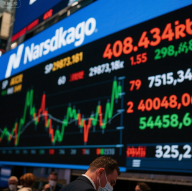
Memory-chip rebound: cycle-recovery logic heats up
Memory chips have always had high beta. Once the market confirms that supply-demand conditions are improving, stock prices often react first. SK Hynix's surge not only reflects its competitive edge in high-end memory, but also sends a signal that the global memory supply chain is recovering in business conditions. Micron's rise in tandem shows that U.S. investors are becoming more receptive to this cycle-recovery story.
That said, investors should note that although memory is highly cyclical and can rebound strongly, earnings delivery often lags share-price action. If end-demand recovery later disappoints, or if the global macro backdrop tightens again, volatility could quickly widen. So this rally is better understood as a sentiment-driven recovery move rather than a fully confirmed long-term uptrend.
IBM plunge: a traditional giant faces a fresh revaluation
In sharp contrast to the semiconductor strength, IBM's plunge was one of the most closely watched events of the session. The stock's drop of more than 25% not only marked its biggest fall since 1987, but also signaled a violent reassessment of its future growth path and earnings quality. For a blue-chip company long viewed as a defensive, stable name, such a decline is extremely rare.
From a capital-market perspective, IBM's sharp fall shows that investors are becoming less tolerant of traditional tech giants. If a company cannot keep delivering a clear growth story, stable profit expansion, and meaningful transformation results, the market will quickly respond with a lower valuation. In a high-rate environment, companies without strong growth support are especially vulnerable to selling pressure.
Market takeaway: divergence is widening, stock selection matters more
Overall, the key feature of today's U.S. market open was not a broad rally or a broad selloff, but a classic structural split: on one side, semiconductors and growth tech benefiting from industry trends; on the other, traditional blue chips hit by weaker growth expectations. For investors, this divergence means stock selection is becoming more important than the index itself.
The market will still need to watch Fed policy signals, the earnings season, and the profit-delivery ability of tech stocks. If inflation and rate expectations remain stable, growth stocks may continue to recover. But if the macro backdrop tightens again, this rebound could also face renewed pullback pressure. Overall, U.S. stocks remain in a phase of high volatility and strong divergence. Only by finding certainty in fundamentals and industry trends can investors better capture the next market leader.
Closing
This opening session once again shows that U.S. stocks are not simply a matter of up or down, but a rapid reallocation of capital across sectors. The rebound in memory chips reflects hope for a cyclical recovery, while IBM's plunge reminds the market that valuation resets can happen at any time. Over the coming period, whether investors can capture new growth from AI and semiconductors will determine which assets receive capital preference and will also shape the internal evolution of the U.S. market.